


Smarter way to manage New York Medicaid EVV and multi-payer compliance
AlayaCare is the EMR software designed for home-based care providers to meet New York's EVV standards, clinical requirements, scheduling, and multi-program operational needs.
Updated: September 1, 2026
New York providers need more than EVV compliance. They need a connected workflow that protects authorized hours, reduces write-offs, and keeps claims moving. When EVV, scheduling, documentation, and billing work together, agencies improve margin and cash flow while staying compliant.
EVV compliance made easy
While EVV follows the same core framework across Medicaid programs, each state can differ in its model, aggregator, covered services, and reporting requirements. The section below outlines key EVV details for New York based providers.
AlayaCare gives New York home care agencies a comprehensive EVV and operations platform built for Medicaid compliance, with direct eMedNY submission and HHAeXchange workflows, automated visit documentation, and seamless connections across scheduling, authorizations, billing, and payroll.
Service types mandated to use EVV
- Personal Care Aide (PCA) Services: Levels I & II
- Consumer Directed Personal Assistance Services (CDPAS): Self-directed care programs
- Home Health Aide (HHA) Services: Provided by Certified Home Health Agencies (CHHAs)
- Skilled Nursing & Therapies: Home health services including nursing, physical, occupational, and speech therapy
- Waiver Programs: Services under NHTD (Nursing Home Transition and Diversion), TBI (Traumatic Brain Injury), and OPWDD Comprehensive waivers
- Children’s Waiver HCBS: Specifically Community Habilitation, Planned Respite, and Crisis Respite
Comptroller audit (2024) found only 56% of PCS and 11% of HHCS services matched to EVV, with major control gaps; recommends stronger edits and oversight.
The State is structurally compliant but control weaknesses and large unmatched volumes could prompt CMS scrutiny or OIG attention if not remediated.
Top flags:
- Huge volume of services (~$14.5B PCS, $97.6M HHCS) without matching EVV during 2021–23, with auditors pushing for edits and recoupments.
- EVV now a fraud‑enforcement focus nationally; NY’s gaps attract oversight.
- High managed‑care penetration magnifies payer‑level EVV compliance demands.
Caregiver-friendly EVV guardrails
With AlayaCare’s EVV-enabled mobile app and IVR solution, New York home care agencies can capture accurate, real-time visit verification at the point of care, helping confirm visits and reduce reliance on paper timesheets, manual callbacks, and disconnected systems.
Built into one unified platform, AlayaCare connects EVV with scheduling, authorizations, client records, documentation, billing, and payroll while also supporting New York workflows such as eMedNY submission and HHAeXchange-connected payer requirements.
The result is a more compliant, audit-ready process that supports caregivers in the field without adding unnecessary friction, so agencies can stay focused on delivering safe, person-centered care.
Take a tour of AlayaCare's Mobile App
All-in-one platform to meet EVV compliance thresholds, protect revenue, and operate with confidence in New York
When EVV is hard on caregivers, it creates downstream problems for the whole agency: missed check-ins, more manual follow-up, disconnected documentation, and more cleanup before billing or audits. AlayaCare is designed to make EVV part of the broader care delivery workflow, helping agencies reduce friction for caregivers while improving accuracy, visibility, and operational control.
| Caregiver frustrations with EVV | How AlayaCare’s caregiver‑first mobile app solves them |
|---|---|
|
Juggling multiple apps and logins just to get through a visit
|
|
|
Documentation that takes time away from providing care
|
|
|
Arriving at visits without the full picture – outdated client information leading to confusion and extra calls to the office
|
|
|
Paper timesheets and manual EVV workflows – increasing errors, back‑office workload, and compliance risk
|
|
|
Fragmented EVV tools that don’t talk to core systems – multiple vendors, duplicate work, and messy audits
|
|
EVV Overview for leadership
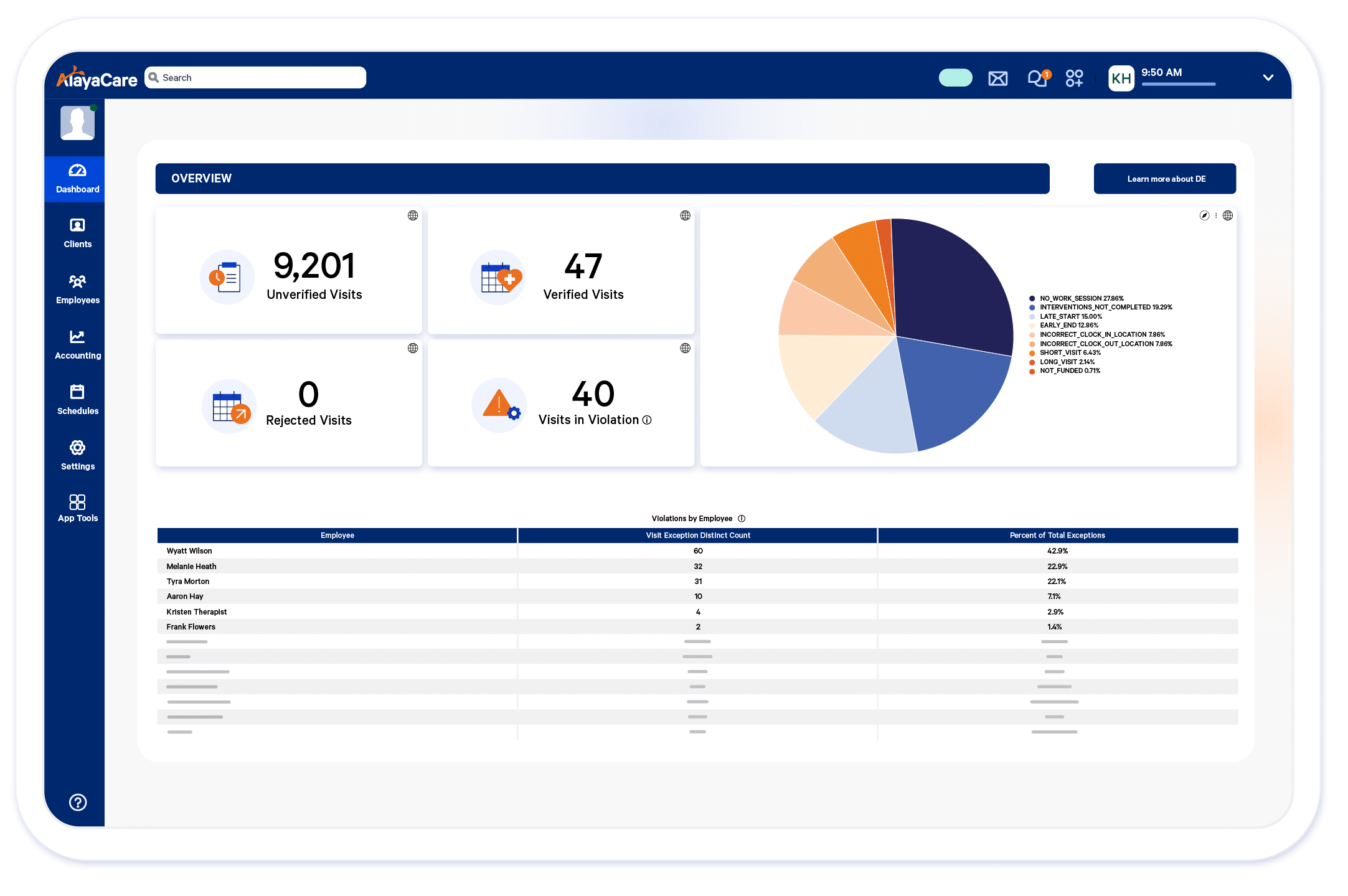
- Gain real-time oversight with a clear view of EVV exceptions, manual edits, and missed clock events across locations
- Spot early warning signs with dashboards that surface gaps before they trigger denials from payors, audit issues, or margin loss
- Strengthen operational control with branch-level visibility into where teams need coaching, process fixes, or staffing
- Improve accountability with audit trails and standardized workflows that show where breakdowns start and who needs to act
- Target faster intervention with insight into the locations and caregivers driving the most EVV risk
Choosing the right EVV approach in New York can be complex — especially with evolving requirements and aggregator changes. Below are answers to common questions from New York providers evaluating EVV solutions and preparing for compliance.
New York EVV frequently asked questions
-
New York uses the NY Medicaid EVV Data Aggregator (HHAeXchange + eMedNY) in an open model and requires EVV for PCA, CDPAS, home health aide services, skilled nursing and therapies, NHTD/TBI/OPWDD waivers, and children’s waiver services such as community habilitation and respite.
-
AlayaCare captures home care waiver visit data at the point of care and is designed to standardize those visits into EVV files that feed New York’s HHAeXchange/eMedNY aggregator for matching against Medicaid claims.
-
Yes—New York allows providers to select their own EVV platform as long as it interfaces with the state aggregator; AlayaCare can be the primary EVV and care delivery management system while sending compliant visit data to the state.
-
Agencies must capture which worker delivered which covered service, to which member, where, and for how long; AlayaCare’s EVV ties these fields to GPS‑verified time stamps and documentation so exported data matches state and MCO expectations.
-
After the Comptroller found only a fraction of PCS and HHCS spending matched to EVV, AlayaCare’s exception handling, missing‑visit alerts, and EVV vs. claims reconciliation reports help agencies close gaps before they lead to recoupments or enforcement actions.
-
With EVV now a fraud‑enforcement focus and New York’s gaps attracting oversight, AlayaCare’s audit trails, role‑based access, and detailed visit history make it easier for agencies to defend their EVV data during payer or state reviews.
-
Given New York’s heavy reliance on Medicaid managed care, AlayaCare lets agencies manage payer‑specific rules and edits on top of state EVV requirements so they can keep their different waiver billing workflows aligned with EVV data in one platform.
-
Electronic Visit Verification (EVV) software pricing in the New York state typically varies based on the size and complexity of your agency. Contact us to receive detailed pricing information tailored to your organization.
-
HHAeXchange is deeply embedded in many New York payer and MLTC workflows. AlayaCare’s value is that it gives providers a more complete, provider-first platform while still supporting HHAeXchange and eMedNY workflows needed in New York.
-
AlayaFlow’s automated Billing Agent runs continuously in the background to monitor failed or in-violation visits. It evaluates existing agency EVV policies, analyzes visit notes, identifies the root cause of verification failures (such as a missed clock-out or location mismatch), and guides caregivers or back-office staff through compliant, audit-ready resolutions. This drastically reduces manual review times and allows administrative teams to focus solely on complex edge cases.
-
Yes. AlayaFlow is designed to act as an intelligent automation layer that works alongside existing Electronic Medical Record (EMR) or Electronic Health Record (EHR) setups. Agencies do not need to replace their current core platforms to benefit from AlayaFlow’s AI-driven exception handling and workflow automation. When paired natively with AlayaCare Cloud, it provides an entirely unified end-to-end ecosystem covering scheduling, clinical documentation, billing, and payroll.
AlayaCare by the numbers
- 700+ Customers
- 10M+ Visits per Month
- $250M Invested in R&D
*These figures reflect AlayaCare globally, not limited to New York.
Awards & Recognitions


Be EVV ready
Get a personalized demo and see how AlayaCare can help your New York agency meet EVV requirements.