A caregiver arrives at a client’s rural home for a morning visit, and their phone shows no cell signal. The visit still needs EVV, so they clock in by phone instead.
The federal EVV deadlines for personal care and home health services have passed, including the extensions. If you’re in a state with an open or provider choice mandate, the decision now is which caregiver mobile app meets your state’s EVV requirements.
The AlayaCare platform is an end-to-end, cloud-based platform with an incorporated mobile, GPS-based EVV that works across every module. Caregivers verify visits by GPS check-in in the mobile app or by IVR (telephony), and both methods feed one integrated system.
EVV requirements for caregiver mobile apps
The 21st Century Cures Act requires Medicaid caregiver mobile apps to capture six data points, the federal minimum for personal care and home health visits. Apps meet those requirements through GPS-enabled mobile check-in, telephony (IVR), or an in-home device, depending on what your state allows.
In its 2018 CMS guidance on Section 12006, the Centers for Medicare & Medicaid Services (CMS) says every EVV system must electronically verify:
- Type of service performed
- Individual receiving the service
- Date of the service
- Location of service delivery
- Individual providing the service
- Time the service begins and ends
The CMS EVV implementation timeline sets two federal deadlines. States had to implement EVV for personal care services (PCS) by Jan 1, 2020 and for home health care services (HHCS) by Jan 1, 2023. CMS good-faith extensions gave states that applied up to one more year: Jan 1, 2021 for PCS and Jan 1, 2024 for home health.
The penalty for missing those deadlines falls on states. According to the CMS FAQ on Section 12006, states face reductions of up to 1 percentage point in federal Medicaid match. For home health, the cut is 0.25 points in 2023–2024 and rises to 1 point from 2027.
Providers don’t pay that federal penalty, but they still face their state’s claim rules.
CMS identifies five state EVV models: provider choice, managed care plan choice, state-mandated in-house, state-mandated external vendor, and open vendor, which CMS calls a hybrid. CMS endorses none of them. Your state’s model decides which apps your caregivers can use.
Beyond the federal floor, EVV compliance requirements vary by state model, aggregator, and covered services. States are adding performance thresholds on top of the federal minimum. For example, Michigan’s Medicaid EVV rules set an 85% auto-verified threshold per quarter, per payer, effective Apr 1, 2026.
Does EVV track caregiver location?
EVV captures caregiver location at the start and stop of each visit, and that meets the federal minimum. Federal rules don’t require GPS or continuous tracking of caregivers as they move through the community. States may still require more location data.
The same CMS guidance on Section 12006 states “there is no requirement to use global positioning services (GPS).” CMS adds that capturing the location where service starts and stops meets the Cures Act minimum. Interactive Voice Response (IVR) is a common alternative to GPS.
A CMS presentation on EVV quality monitoring confirms that continuous tracking of caregivers “is not required.” CMS also lets states require more information to control fraud, waste, and abuse. Check your state’s rules before you choose an app.
Handling telephony verification within EVV
In states that use caller ID, EVV software verifies telephony visits by matching the caller’s number to a phone registered in the client’s profile. The caregiver calls an interactive voice response (IVR) line at clock-in and clock-out. Landline rules and no-landline fallbacks vary by state.
A CMS presentation on EVV describes telephonic EVV as caregivers checking in and out “from the member’s landline and utilizing interactive voice response (IVR).” The CMS Section 12006 FAQ confirms an EVV system doesn’t require the client to have an internet connection, a cell phone, or a landline.
The HHS-OIG audit of Colorado’s EVV system explains: “Using GPS or caller ID, the EVV system identifies the enrollee and the authorized services.” Providers enter known phone numbers into the client’s EVV profile, which links to the client’s primary address. HHS-OIG flags the risk: A caregiver could call from home on an approved number, and the system “would still assign the enrollee’s address.”
Landline rules differ by state.
- The Texas HHSC EVV Policy Handbook says the landline must be the client’s home phone or a landline where they frequently receive services. Texas HHSC also requires agencies to enter the number in the EVV system first, and cell phones must use the mobile method.
- The Pennsylvania DHS EVV FAQ states, “EVV does not require participants to have a landline home phone.” Pennsylvania DHS allows cell phone telephony only with a location method, such as an in-home fixed device. HHS-OIG reports that Colorado permits both landlines and cell phones, so check your state’s current EVV policy.
When a client has no landline, CMS points to a one-time password (OTP) device or fob in the home that generates unique visit codes. Caregivers enter those codes through IVR “from another telephone or an online portal.” Texas HHSC puts limits on that fallback. Device codes expire seven days from the date of the visit. Beginning Sept 1, 2028, providers must limit alternative-device visit transactions to 5% of their total visit transactions.
Manual entries are the last resort. AlayaCare’s EVV solution supports IVR alongside the mobile app, so caregivers can clock in by phone when GPS check-in isn’t an option. Its configurable EVV QA rules flag exceptions for review before your team approves a visit.
Introducing AlayaCare’s Electronic Visit Verification (EVV) solution
AlayaCare EVV verifies every visit through GPS-enabled mobile check-in or IVR (telephony) and sends date- and time-stamped visit reports to the office. Meet state EVV mandates and get reliable proof of every visit with AlayaCare’s EVV solution.
With AlayaCare EVV, your agency can:
- Gain reliable proof of visit
- Increase compliance and efficiency
- Capture GPS-enabled verification or IVR (telephony)
- Generate date and time stamped visit reports
- Create and receive real-time schedule updates
- Categorize and analyze visit data with advanced reporting
- Benefit from secure communication between caregivers and the office
Agency challenges and how AlayaCare EVV solves them
Home care agencies face four recurring EVV challenges: paper-based check-ins, missing mobile apps, caregiver travel to remote or unfamiliar areas, and slow post-visit quality assurance. Each challenge below is paired with how AlayaCare EVV solves it.
Challenge #1: Paper-based visit check-ins
Many organizations still don’t have an adequate software solution that enables caregivers to check in to client visits or submit real-time data to remain compliant with state EVV mandates. Home care continues to be labor intensive largely because several stakeholders remain loyal to the paper world.
Solution
AlayaCare is an end-to-end software platform with a fully integrated and compliant EVV solution that allows caregivers to document their visits in real-time, at the point of care, so supervisors can track activity as it happens. North Country Home Services reached 95% EVV with AlayaCare. If you’re in an open or provider choice state, AlayaCare EVV lets you choose your own app and keep verification inside one platform.
Challenge #2: No built-in mobile EVV app
Many software vendors don’t offer a mobile app resulting in tedious EVV workarounds. Some organizations are finding the need to outsource to a third party EVV vendor which can be quite costly.
Solution
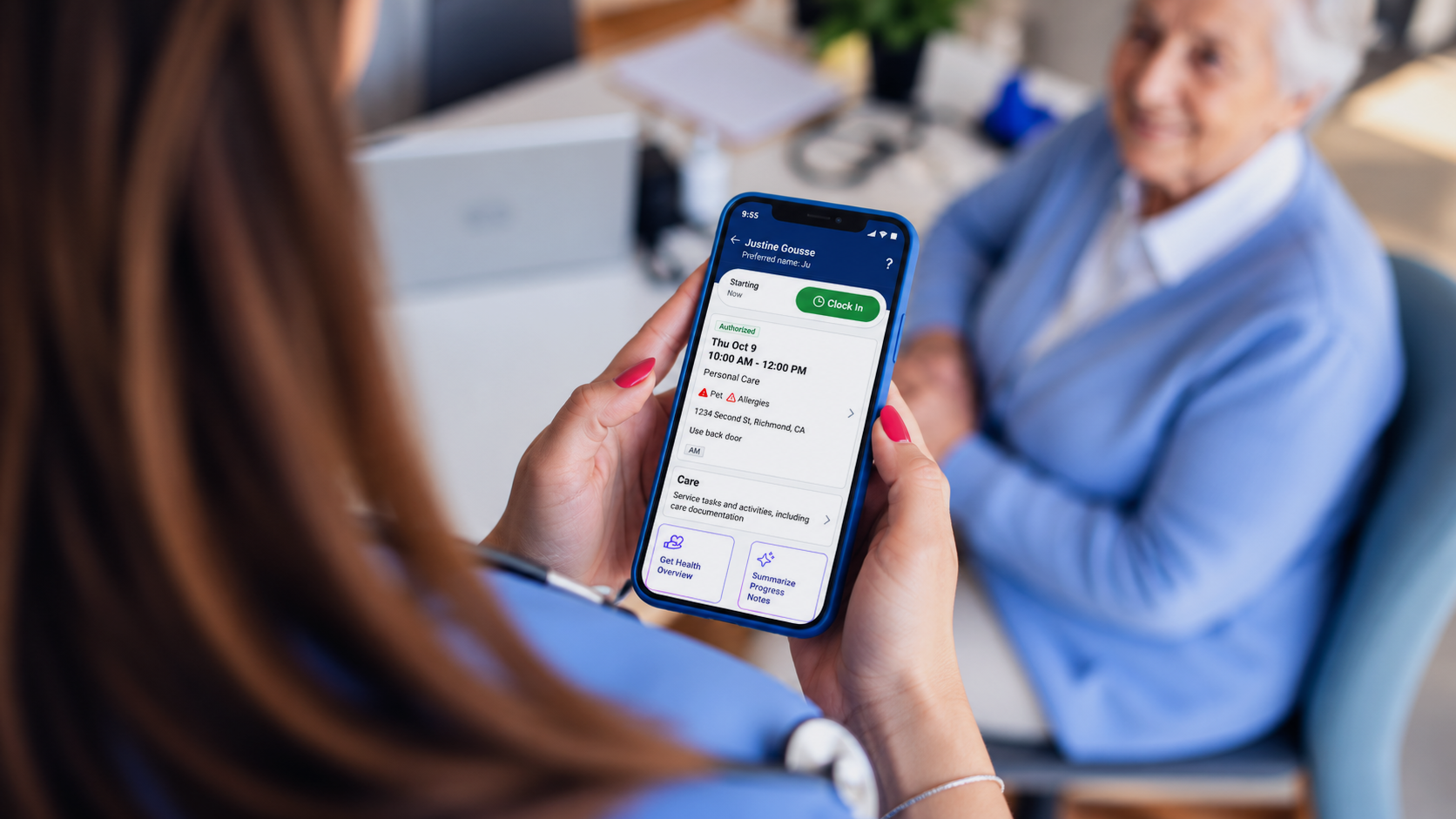
AlayaCare’s integrated EVV solution is built into our native mobile app, with one-tap clock-in and clock-out and GPS verification. Caregivers can clock in and out only when they’re within the approved radius of the client’s home during the scheduled visit.
An offline mode covers areas out of cellular or Wi-Fi range. IVR is available in multiple languages and dialects, and the app supports more than 10 languages.
Challenge #3: Caregivers traveling to remote or unfamiliar areas
Many caregivers, particularly those working in remote areas but also for some in urban centers, often travel extensive distances or into unfamiliar neighborhoods. For these caregivers, EVV does double duty: it records the visit for compliance and tells the home office where they checked in.
Solution
Aside from remaining compliant, being able to offer peace of mind that the home office can check in and verify location in real-time is a subtle, but real, added perk for top talent.
Challenge #4: Slow post-visit quality assurance
Some home care EVV solutions lack critical Quality Assurance resulting in hours of post-visit data validating. Without automated QA rules, office staff check clock-in times, visit durations, authorizations, and GPS exceptions one visit at a time.
Solution
The HHS Office of Inspector General EVV audits include a July 2026 single-state review of Colorado’s personal care services. That audit recommended Colorado adopt edits “that require providers to review and then correct GPS exceptions.” AlayaCare’s audit-ready compliance workflows flag those exceptions for review using configurable EVV QA rules and exception flags.
AlayaCare has built in QA best practices. Business rules and logic streamline the approvals process. Visits that violate logic are flagged as red. Agencies can adjust certain settings for automated approval:
- Start time allowance (what is the permitted clock-in time vs. scheduled start time)
- Visit duration (what is the percentage of time completed vs. scheduled time)
- Authorizations (was a visit within the limits of the payer)
- GPS/Telephony exceptions (are there differences between GPS distance and a client’s address)
- Tasks completed (what constitutes a required task that is finished)
AlayaCare EVV software solution
AlayaCare’s EVV feature gives your agency GPS or IVR verification and date and time stamped visit reports in one integrated system. Whether your agency runs on paper documentation or a dated legacy solution, AlayaCare replaces both with EVV built into one end-to-end platform.
Learn more about how we can help drive your organization forward.
Frequently asked questions
Not under federal rules that say an EVV system doesn’t require the beneficiary to have an internet connection, a cell phone, or a landline. AlayaCare’s EVV app pairs IVR with GPS check-in in the mobile app, so a missing landline doesn’t stall the visit.
CMS notes a one-time password (OTP) device or fob in the home generates codes caregivers enter through IVR “from another telephone or an online portal.” Where your state allows mobile check-in, AlayaCare’s EVV app verifies visits by GPS in the mobile app, and offline mode covers areas with no signal.
CMS describes IVR as checking in and out “using a landline or cellular device located at the individual’s home,” but check your state’s current EVV policy. In Texas, cell phones must use the mobile method under the Texas HHSC EVV Policy Handbook; in Pennsylvania, the Pennsylvania DHS EVV FAQ requires a paired location method. AlayaCare EVV supports both GPS check-in in the mobile app and IVR.
Pennsylvania DHS lets missed check-in and check-out times be manually entered in the PA-DHS EVV System and says to keep supporting hard copy documentation. The Texas HHSC EVV Policy Handbook warns, “Manually entered visits will negatively impact the EVV Usage Score,” so check your state’s current EVV policy. AlayaCare EVV flags these visits with configurable EVV QA rules, so your team can review and correct them before approval.
Medicaid fraud and payment errors drove the mandate. HHS-OIG says EVV targets personal care program weaknesses that contribute to “improper payments, questionable quality of care, and notable amounts of fraud.” The 21st Century Cures Act requires states to use EVV for Medicaid personal care and home health services, as the CMS Section 12006 FAQ explains.
Look for telephony exception flags: An HHS-OIG audit warns a caregiver calling from home on an approved number still gets logged at the client’s address. We recommend AlayaCare EVV, which pairs GPS mobile check-in with IVR in 10 languages, from Spanish to Tagalog, plus offline mode. Its configurable EVV QA rules flag exceptions for review, and our end-to-end platform links EVV to scheduling, billing, and payroll.
The penalty falls on the state. According to the CMS FAQ on Section 12006, states that miss the deadline face reductions of up to 1 percentage point in federal Medicaid match. For home health, the cut is 0.25 points in 2023–2024 and rises to 1 point from 2027. Providers don’t pay that penalty, but they still face their state’s claim rules.
An EVV system must electronically verify six elements. They are the service type, the person receiving it, the date, the location, the person providing it, and start and end times. That’s the federal minimum, and your state’s model and vendor rules decide which app you may use.
Updated , originally published