


Meet Minnesota’s 80% EVV threshold with less effort and more confidence
With AlayaCare, connect scheduling, clinical documentation, and automated EDI transfers to Minnesota’s aggregator. Move from verified visit to clean claim in one connected workflow.<br />
Updated: October 5, 2026
Minnesota providers need more than EVV compliance. They need a connected workflow that protects authorized hours, reduces write-offs, and keeps claims moving. When EVV, scheduling, documentation, and billing work together, agencies improve margin and cash flow while staying compliant.
EVV compliance made easy
While EVV follows the same core framework across Medicaid programs, each state can differ in its model, aggregator, covered services, and reporting requirements. The section below outlines key EVV details for Minnesota based providers.
AlayaCare supports Minnesota’s open-vendor EVV model with a Minnesota-specific HHAeXchange integration. Caregivers capture required visit data—including worker, member, service, date, time in/out, and location—in a mobile workflow, with offline functionality for low-connectivity areas. AlayaCare then transmits visit data to HHAeXchange, helping agencies monitor performance against Minnesota’s current 80% EVV compliance threshold and resolve exceptions earlier.
By connecting EVV with scheduling, care management, billing, and payroll workflows, AlayaCare helps teams reduce duplicate entry, support audit readiness, and lower the risk of rework, payment holds, and corrective action notices.
Service types mandated to use EVV
- Personal Care Assistance (PCA): Services aiding with Activities of Daily Living (ADLs) and Instrumental Activities of Daily Living (IADLs).
- Community First Services and Supports (CFSS): Including worker training and development.
- Home Health Services: Skilled nurse visits, home health aide services, and home health therapies (OT, PT, respiratory, speech).
- Waiver Services: Certain in-home waiver services, including Consumer Directed Community Supports (CDCS) and Consumer Support Grants (CSG).
- Jan 2026 50% and July 2026 80% compliance thresholds explicitly tied to DHS enforcement.
- All providers (including PDN, waivers, FMS, MCOs) are within scope, increasing complexity for multi‑line agencies.
- Small agencies risk corrective actions and network exclusion if they cannot meet thresholds quickly.
Caregiver-friendly EVV guardrails
With AlayaCare’s EVV-enabled mobile app, caregivers can clock in and out only when they are within the approved radius of the client’s home during the scheduled visit. This gives agencies reliable proof-of-visit while replacing paper timesheets and manual phone calls with real-time, point-of-care verification.
EVV is fully integrated into AlayaCare’s mobile experience and agencies’ operations, unifying schedules, client information, visit documentation, and billing in a single intuitive platform instead of forcing staff to juggle multiple tools.
By design, AlayaCare supports EVV and compliance requirements without making caregivers feel tracked or mistrusted, embedding GPS verification and audit-ready documentation into everyday workflows while keeping the focus on delivering safe, person‑centered care.
Take a tour of AlayaCare's Mobile App
All-in-one platform to meet EVV compliance thresholds, protect revenue, and operate with confidence in Minnesota
When EVV is hard on caregivers, it creates downstream problems for the whole agency: missed check-ins, more manual follow-up, disconnected documentation, and more cleanup before billing or audits. AlayaCare is designed to make EVV part of the broader care delivery workflow, helping agencies reduce friction for caregivers while improving accuracy, visibility, and operational control.
| Caregiver frustrations with EVV | How AlayaCare’s caregiver‑first mobile app solves them |
|---|---|
|
Juggling multiple apps and logins just to get through a visit
|
|
|
Documentation that takes time away from providing care
|
|
|
Arriving at visits without the full picture – outdated client information leading to confusion and extra calls to the office
|
|
|
Paper timesheets and manual EVV workflows – increasing errors, back‑office workload, and compliance risk
|
|
|
Fragmented EVV tools that don’t talk to core systems – multiple vendors, duplicate work, and messy audits
|
|
EVV Overview for leadership
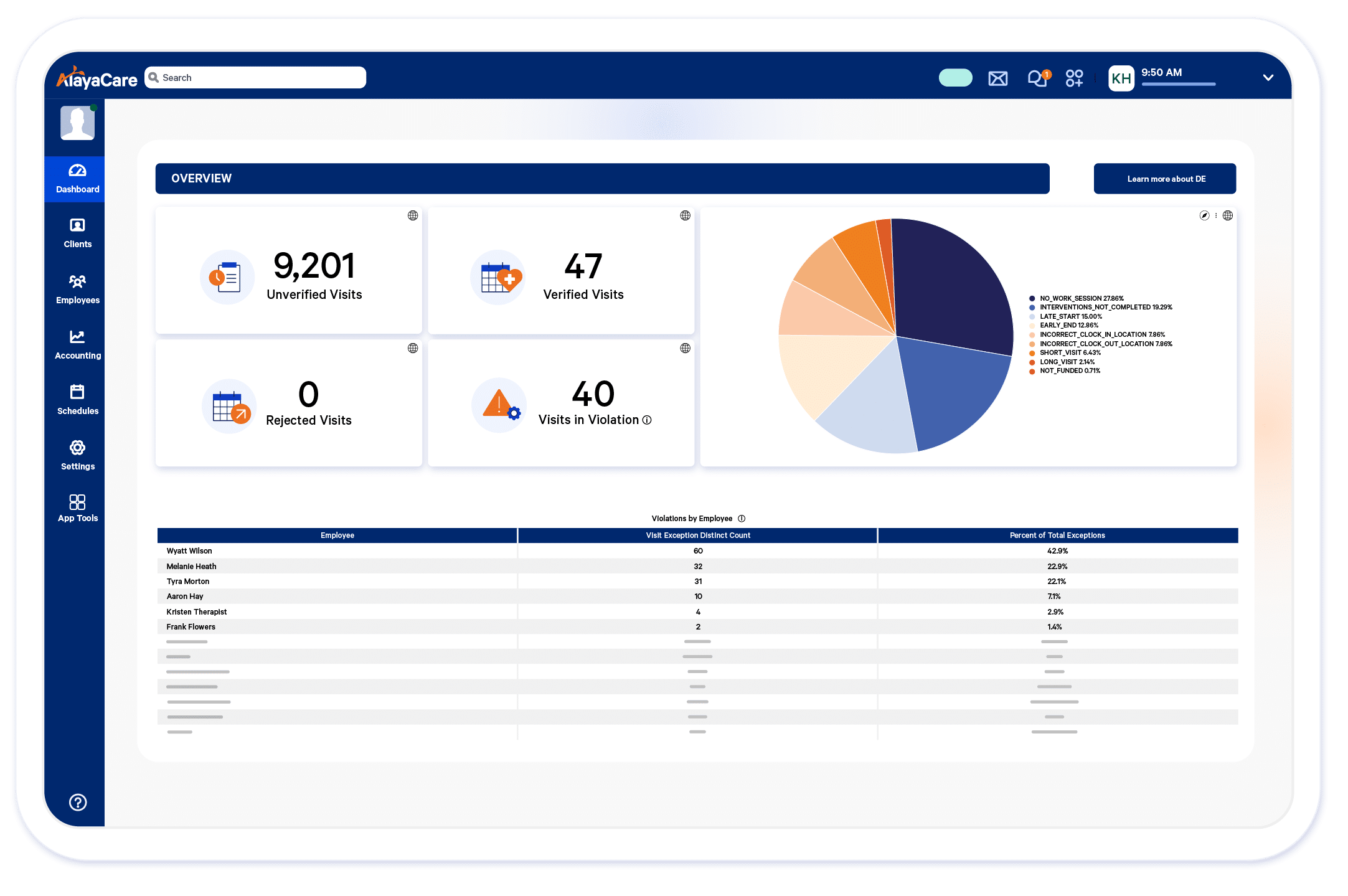
- Gain real-time oversight with a clear view of EVV exceptions, manual edits, and missed clock events across locations
- Spot early warning signs with dashboards that surface gaps before they trigger denials from payors, audit issues, or margin loss
- Strengthen operational control with branch-level visibility into where teams need coaching, process fixes, or staffing
- Improve accountability with audit trails and standardized workflows that show where breakdowns start and who needs to act
- Target faster intervention with insight into the locations and caregivers driving the most EVV risk
Choosing the right EVV approach in Minnesota can be complex — especially with evolving requirements and aggregator changes. Below are answers to common questions from Minnesota providers evaluating EVV solutions and preparing for compliance.
Minnesota EVV frequently asked questions
-
Minnesota uses HHAeXchange as a state‑selected EVV aggregator in an open model and requires EVV for PCA, CFSS, home health nursing and aide services, home health therapies, and certain in‑home waiver services such as CDCS and CSG.
-
AlayaCare’s mobile app captures EVV data for PCA, CFSS, home health, and waiver visits and can be configured to generate HHAeXchange‑ready files, helping agencies align with DHS rules across multiple service lines.
-
Yes—Minnesota allows third‑party EVV systems that integrate with HHAeXchange; AlayaCare can act as the caregiver‑facing EVV platform and back‑office system while sending required visit data into the state aggregator.
-
Providers must record worker, member, covered service, date, time in/out, and location for all EVV‑mandated visits; AlayaCare’s EVV combines GPS‑verified clock‑ins, program tags, and documentation to produce DHS‑ready EVV exports.
-
DHS requires at least 50% EVV compliance for all billed visits from January 1, 2026, and 80% compliance from July 1, 2026; AlayaCare’s dashboards and alerts help agencies track their EVV completion rate and quickly resolve exceptions to stay above those thresholds.
-
Because Minnesota’s EVV rules apply to PDN, waivers, FMS, MCOs, and more, AlayaCare lets agencies manage EVV across different programs and payer types in one system, reducing complexity for multi‑line organizations.
-
Smaller agencies risk corrective actions and network exclusion if they can’t meet DHS thresholds quickly; AlayaCare’s EVV reporting and workflow tools give them enterprise‑grade visibility so they can improve compliance before payers or DHS intervene.
-
Electronic Visit Verification (EVV) software pricing in Minnesota typically varies based on the size and complexity of your agency. Contact us to receive detailed pricing information tailored to your organization.
AlayaCare by the numbers
- 700+ Customers
- 10M+ Visits per Month
- $250M Invested in R&D
*These figures reflect AlayaCare globally, not limited to Minnesota.
Awards & Recognitions




Be EVV ready
Get a personalized demo and see how AlayaCare can help your Minnesota agency meet EVV requirements.