Most aged care leader’s first question about AI is the wrong one.
Instead of asking which tool to buy, it should be asking who governs it.
Before you trial any AI tool, you need the basics in place. That means board accountability, clinical oversight, consent processes, escalation pathways and audit trails.
This was the focus in AlayaCare’s recent webinar, AI and clinical governance: Managing risk in home, community and residential care.
As Director, CS Enablement and Customer Advisory at AlayaCare, Kristen Solomon put it, “Governance starts before the technology, and it starts at the board level.”
AI is already part of care and business workflows. It can show up in care planning, incident reporting, transcription, risk monitoring and workforce processes. Senior Managing Director at FTI Consulting, Nicki Doyle stated during the webinar, “AI is actually already here.” The risk is not just poor adoption. It is using AI before your governance has caught up.
Watch the AI and clinical governance: Managing risk in home, community and residential care now
If you do not know where AI is already being used, you cannot govern it properly. You cannot assess clinical risk, explain its role to clients and residents, or show that staff can question or override it when needed.
Why AI governance in aged care cannot wait
This is not just an IT issue.
As Nicki said, “clinical governance is now a statutory board duty”. In aged care, the governing body is responsible for clinical governance. That means AI oversight cannot be left to operations or technology teams alone. It needs board oversight, clear accountability and regular review.
The same principle applies in practice. AHPRA is clear that practitioners remain responsible for safe and quality care when using AI. They must apply human judgement to AI outputs, understand the tool well enough to use it safely, and inform patients and clients when AI is involved in care.
As Nicki said, “AI should always augment, not replace clinical judgment.” That is the core test for any AI use case in aged care: does it support professional judgement, or does it quietly weaken it?
What good governance looks like before adoption
Putting governance first does not mean slowing innovation to a crawl. It means setting the rules before the technology shapes practice for you.
In practical terms, that starts with five basics:
- An AI inventory, so you know every tool and feature already in use
- Named clinical accountability for each AI system used in care
- Clear consent processes written in plain language
- Escalation pathways for staff to question, override or report an AI output
- Audit trails that show what the AI suggested, what the clinician decided and why
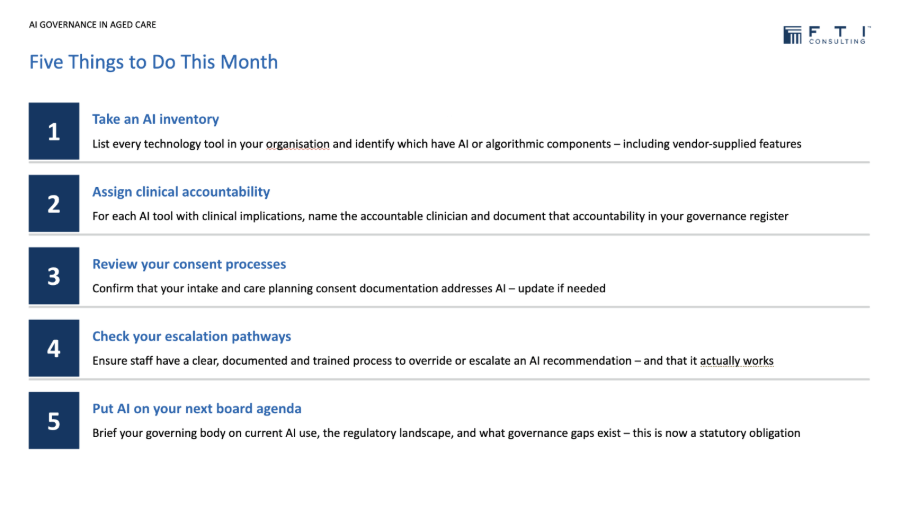
These are baseline controls. They stop AI from becoming a black box in your care model.
They reflect the core governance controls raised in AlayaCare’s webinar: oversight, clinical accountability, audit trails and escalation pathways.
Want to see more? Book a demo and speak to an expert
The risks grow when AI arrives before governance
AI can reduce admin time, surface patterns earlier and support better documentation. None of that removes the core risks in aged care.
Consent, privacy and dignity come first. If AI is recording conversations, monitoring behaviour or analysing personal information, people need to understand what is happening and how their information is being used. AHPRA’s guidance is explicit on this point: when AI tools use personal data, informed consent matters, and practitioners need to be clear about privacy implications.
There is also the risk of missed deterioration, false alarms and staff over-reliance. If staff trust the tool more than their own judgement, care quality can slip. As Senior Managing Director at FTI Consulting, Sabine Bennett, put it, “Ultimately, your clinician is still accountable. So the accountability is not transferable.”
Bias matters too. If a model has not been trained or tested on the populations you support, outcomes may be less reliable for First Nations communities, culturally and linguistically diverse groups, and people with complex needs. AHPRA also warns practitioners to understand bias in data and algorithms before using AI in practice.
Then there is the accountability gap. If something goes wrong, you need to know where responsibility sits across the vendor, your internal teams and registered clinicians. If that is unclear, governance breaks down fast.
Board accountability is the starting point
If you want AI governance in aged care to work, it has to start at the top.
Your board should not approve AI in principle and leave the detail to operations. It should set the organisation’s risk appetite, require reporting, and make sure AI is visible on the risk register. It should expect regular updates on where AI is used, what risks have emerged and whether the intended benefits are actually being achieved.
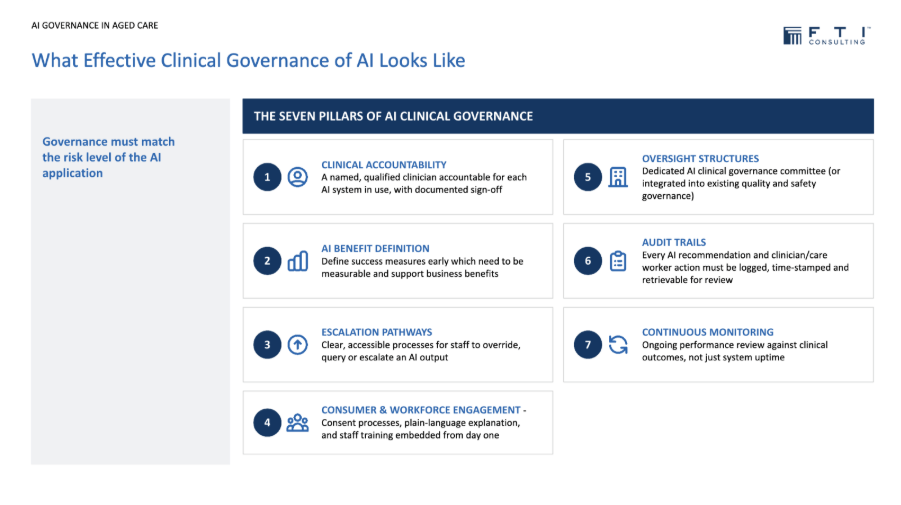
Executive and clinical leaders then need clear rules for use, review and escalation. Who approves a new AI use case? Who reviews incidents? Who measures outcomes? Who decides when a tool should be paused, retrained or removed?
If those questions do not have names beside them, your governance is still too loose.
Five steps to take this month
If you are early in your AI journey, do not start with a product demo. Start here.
1. Take stock of every AI tool already in use
Look for standalone tools, built-in product features and unofficial team use. Hidden use is still use.
2. Assign a clinical owner to every care-related AI system
If a tool touches care delivery, someone clinically qualified should be accountable for reviewing its role, risks and performance.
3. Review your consent and disclosure processes
Check whether your current language explains AI clearly. People should know when AI is involved and how their information is handled.
4. Build an override and escalation process
Staff need a documented path to question an output, override it and report a concern. Informal workarounds are not governance.
5. Put AI on the next board agenda
If AI is already in your workflows, board oversight cannot wait for a later phase.
Adopt AI with your eyes open
AI can reduce admin and help teams spot risk sooner. In aged care, though, better technology does not reduce your duty of care. It raises the standard for how clearly you govern it.
Start with the fundamentals. Know where AI is used. Decide who owns it. Explain it clearly. Give staff a way to challenge it. Record what happened.
That is how you build AI adoption that is safe, credible and ready for scrutiny from boards, regulators and families.
See how AlayaCare supports governance-ready AI adoption across home, community and residential care.
Frequently asked questions
AI governance in aged care is the set of rules, responsibilities and checks that guide how AI is selected, used and monitored in care settings.
Because AI can affect care quality, safety and compliance from day one. If governance comes later, accountability, consent and override pathways are usually weak or missing.
Yes. AHPRA is clear that practitioners must apply human judgement to AI outputs and remain responsible for safe and quality care.
At a minimum, it should capture the AI recommendation, the clinician’s final decision, whether the output was overridden, and why.
Published