Nearly every bed is full, yet most homes are losing money. StewartBrown’s March 2026 Aged Care Financial Performance Survey found that 62% of residential aged care homes recorded an operating loss in the nine months to March 2026, averaging $9.16 per bed day despite 95.2% occupancy.
Additional Services had become an important source of revenue, with the share of homes earning it more than doubling from 18.3% in FY22 to 41.6% in FY25 (StewartBrown). Since 1 November 2025, the Higher Everyday Living Fee (HELF) has replaced it, and many providers are finding HELF harder to get right.
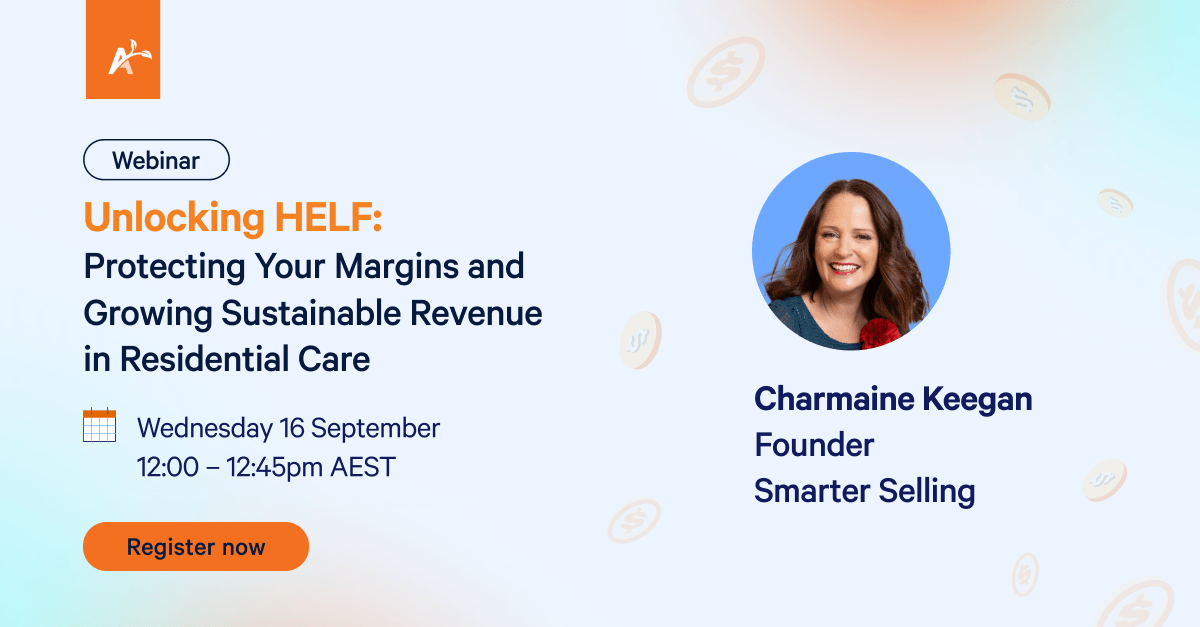
In AlayaCare’s Unlocking HELF webinar, Charmaine Keegan, Director of Smarter Selling, and Bonnie Nicholas, Business Development Manager at AlayaCare, explored why. Their answer: the fee is rarely the problem. The conversation is, and it only works when the team believes in it first.
What is shaping residents’ decisions about HELF?
For many homes, Additional Services came with the room, so teams rarely had to explain its value. With HELF, residents choose whether to opt in, and someone has to make the case. Most providers are already there: based on our survey of providers 58% had moved to HELF, and the rest were starting to offer it or preparing to launch.
As Charmaine put it, “The reason the resident is not on board is because the team are not on board.” When staff aren’t convinced, they put the conversation off, avoid or dismiss it, and residents notice.
Part of the reluctance is the word “selling”. Many staff come from nursing, social work or care backgrounds and didn’t choose aged care to ‘sell’. Charmaine offers a different frame: the team is the link between what a resident need and the services that can add to their quality of life.
When does a HELF conversation build confidence, and when does it create doubt?
Two-thirds (67%) of providers we surveyed said their teams were still building confidence with HELF, and others said their teams knew the detail but needed more coaching and practice. As Charmaine says, there’s no such thing as private thoughts. If staff think HELF is unfair, the fee is too expensive, or decide the family can’t afford it, residents will hear it in the staff members tone, whatever the script says.
Leaders set the tone. As Charmaine puts it, “The first sale in any organisation has to be your own team.”
Language gives it away too. Phrases from the leader like “we have to” or “the government is making us” sound reluctant, while talking about what HELF adds to residents’ lives does the opposite. Well-meant reassurance can also backfire:
‘When you address your team: don’t say ‘I know you think its unfair’ or ‘it’s not expensive’, because your team will hear the word expensive.”
Charmaine Keegan, Director of Smarter Selling.
It helps to treat HELF as a normal choice, like the coffee, streaming service or better flight seat people already pay extra for.
Every touchpoint counts. From the first phone call to the tour and follow-up, a shared process means families hear the same clear message each time. That’s why Charmaine recommends upskilling everyone who speaks with residents and families, from customer service and clinical staff to hotel services, lifestyle and allied health.
Want to see more? Book a demo and speak to an expert
How do we show the value to residents and their families?
The hardest part is showing what HELF is worth. Almost six in ten (59%) providers surveyed named this as their biggest barrier, and nearly a quarter (24%) said the offer is hard to explain clearly. The conversations are happening; they just aren’t landing yet.
Handing over a brochure shares information, but it doesn’t show value. Going line by line doesn’t either: “Does Dad use this? Does he use that?” It invites families to rule services out one at a time, yet no one judges a gym membership on every feature. As Charmaine puts it, “It’s there if you need it.” If the services a resident want would cost $32 separately and the package is $36, the package can be the easier choice.
Also, as Charmaine points out, that isn’t the way you sell. You first find out, then you show what is of value that you have that matches what they will use.
The strongest conversations let residents and families do most of the talking. Questions about routines, interests and friendships help teams connect the package to what matters and bring hesitation to the surface early. If family members see things differently, the decision still belongs to the resident. Team’s need to be skilled on sales skills. For example the adult children of the aged person may say ‘Dad doesn’t use that’ but we know that people change once they settle in: a resident who doesn’t go on bus trips may enjoy an outing to the RSL with a new friend.
Charmaine and Bonnie also cautioned against opening with trial periods or cancellation terms. Everyone should understand their options, and HELF won’t be affordable or right for everyone. But the conversation should lead with what the offer could add, not how to leave it.
Then there’s timing. As Charmaine put it, “Don’t leave the conversation about HELF it to the tour.” A tour can be overwhelming for someone considering a move, so raising HELF from the first contact gives families time to think and teams time to learn what each resident values.
Protecting margins starts with the conversation
With 62% of homes running at a loss despite near-full occupancy, filling beds isn’t enough. HELF can strengthen revenue while giving residents more choice, but whether they choose it often depends on the people explaining it.
A simple first step is Charmaine’s two-minute exercise: ask your team what they really think of HELF, and why. Their answers will show where the conversation needs to start.
Watch the on-demand HELF webinar to hear the full conversation between Charmaine and Bonnie.
Frequently asked questions
The Higher Everyday Living Fee (HELF) is an optional fee residents in residential aged care can choose to pay for everyday living services above the standard level, such as a wider choice of meals, entertainment or outings. It replaced Additional and Extra Services on 1 November 2025.
For many homes, Additional Services were a condition of entry, so teams rarely had to explain their value. With HELF, residents choose whether to opt in. Staff now need to explain clearly what the package offers and how it fits each resident’s everyday life.
Start with your own team. When staff understand the package and believe in what it offers, residents and families notice. Avoid going through services line by line, let residents and families lead the conversation, and introduce HELF from the first contact rather than leaving it to the tour.
Published