
What does it take to grow a home care organization when workforce pressures are relentless, technology is evolving fast, and margins are razor-thin? We brought together three industry leaders to find out.
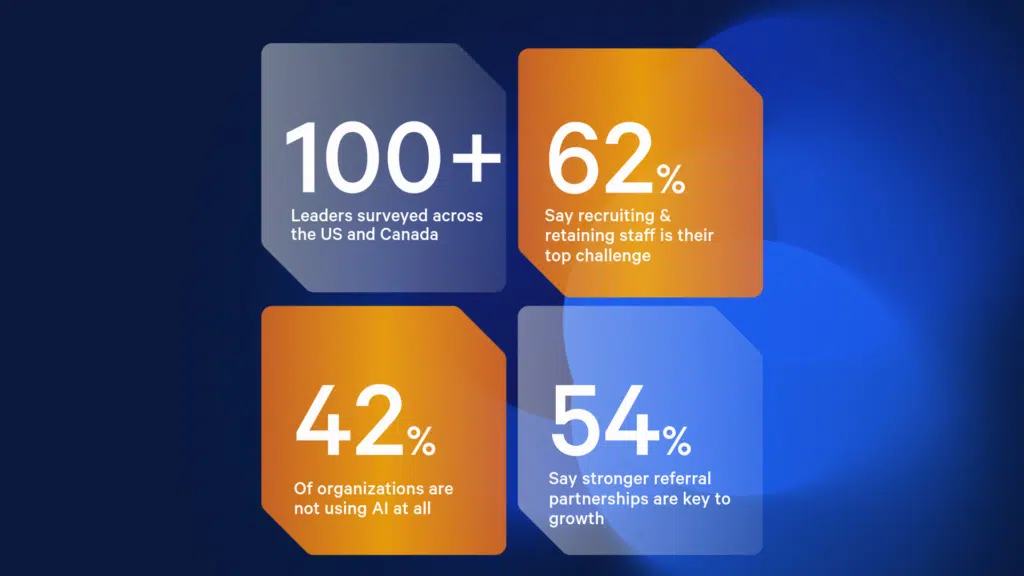
In November 2025, AlayaCare partnered with Home Health Care News to survey more than 100 home care leaders across the United States and Canada. The results surfaced four themes that cut across every type of organization. Moderated by Kaila Raimondo, AlayaCare’s Head of US Home-Based Care, Home Infusion, and Private Duty Nursing Markets, the conversation featured three seasoned voices from across the industry:
- Jen Lentz, CEO of Avid Health at Home
- Andrew Prahalad, VP of IT at CBI Home Health
- Rob Simione, SVP of Consulting Services at SimiTree
Workforce remains the industry’s biggest barrier
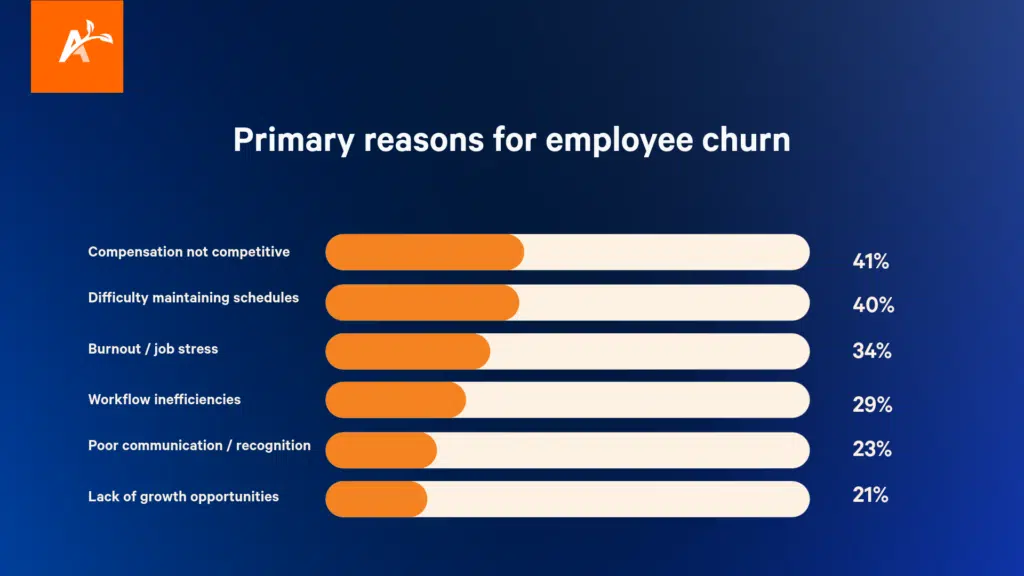
62% of providers cited recruiting and retaining staff as their biggest challenge — a number that has barely moved in a decade. Compensation tops the turnover list at 41%, but reimbursement rates in some states actually declined this year, leaving providers with little room to move on wages. The organizations doing retention well are focused instead on reducing the friction of the job itself: better-structured care notes, tools that connect isolated caregivers to a wider team, earned wage access, and communication that makes staff feel seen rather than managed.
Where organizations consistently stumble is in how they introduce change. Top-down rollouts fail. The providers that hold staff through operational transitions are the ones that involve their teams early, surface internal champions, and answer the question every caregiver is asking: what’s in it for me?
Where organizations consistently stumble is in how they introduce change. Top-down rollouts fail. The providers that hold staff through operational transitions are the ones that involve their teams early, surface internal champions, and answer the question every caregiver is asking: what’s in it for me?
“Change management is where high performers separate themselves. You have to incorporate your team at day one — top-down never works. Find your champions, communicate the value, and make sure everyone knows what’s in it for them.”
Rob Simione — SVP Consulting, SimiTree
Andrew Prahalad described how CBI Health approached the problem by systematically investigating where frontline staff experience the most friction. His team went back to fundamentals — communication, scheduling, coordination — and deployed technology intentionally to reduce that friction. They also launched an Earned Wage Access program, giving employees more financial flexibility, and extended corporate device plans to employees’ family members as a non-traditional retention benefit.
Fragmented systems are stealing time from care
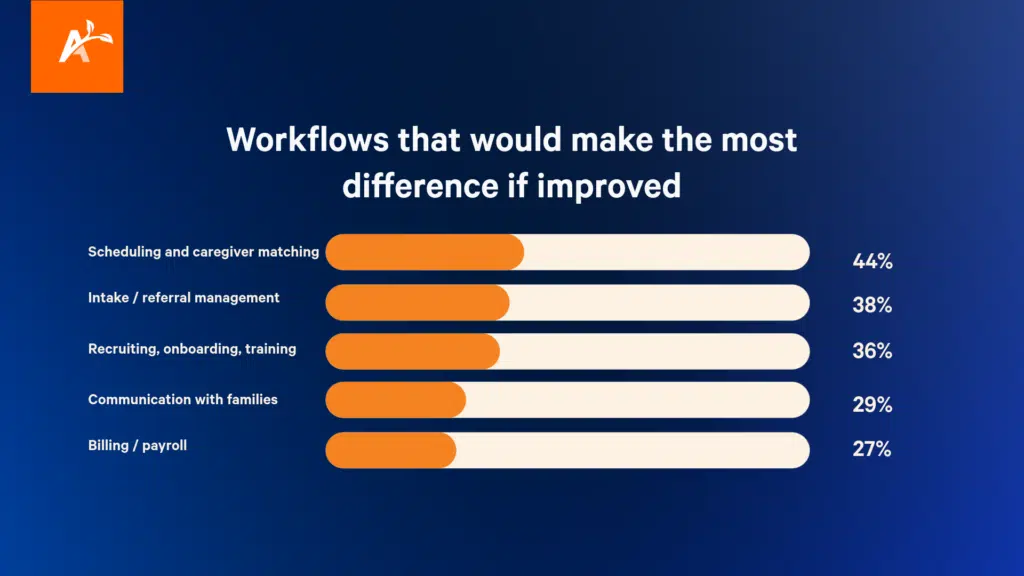
44% of providers say scheduling and caregiver matching is the workflow most in need of improvement, with intake and referral management close behind at 38%. The intake process matters disproportionately — errors there don’t stay contained. Poor data at referral cascades into scheduling conflicts, compliance gaps, and billing inaccuracies. Organizations that respond by adding headcount tend to compound the problem rather than solve it. The issue is process design and data quality at the source.
Fixing that pipeline pays dividends fast. Avid Health at Home connected their job boards, onboarding workflow, and scheduling system and cut time-to-first-shift from several days down to 24–78 hours — meaning a new hire could apply on Wednesday and start with a caseload by Friday.
At CBI Health, early automation wins came from identifying high-volume, low-judgment tasks and systematically removing the human from them. The discipline that exercise requires — naming exactly what work is being done, by whom, and why — turned out to be as valuable as the automation itself.
“If intake isn’t right, everything downstream goes wrong. I can’t tell you how many organizations spend three hours in a meeting talking about how the data is wrong. That’s just waste. Get the front-end right, and the rest starts to work.”
Rob Simione — SVP Consulting, SimiTree
Key Takeaway
Workflow design is a retention strategy. When the job feels manageable — when caregivers aren’t fighting systems to do their work — they stay. Operational improvement and workforce stability aren’t separate priorities. They’re the same one.
AI adoption is happening: But most providers are still early
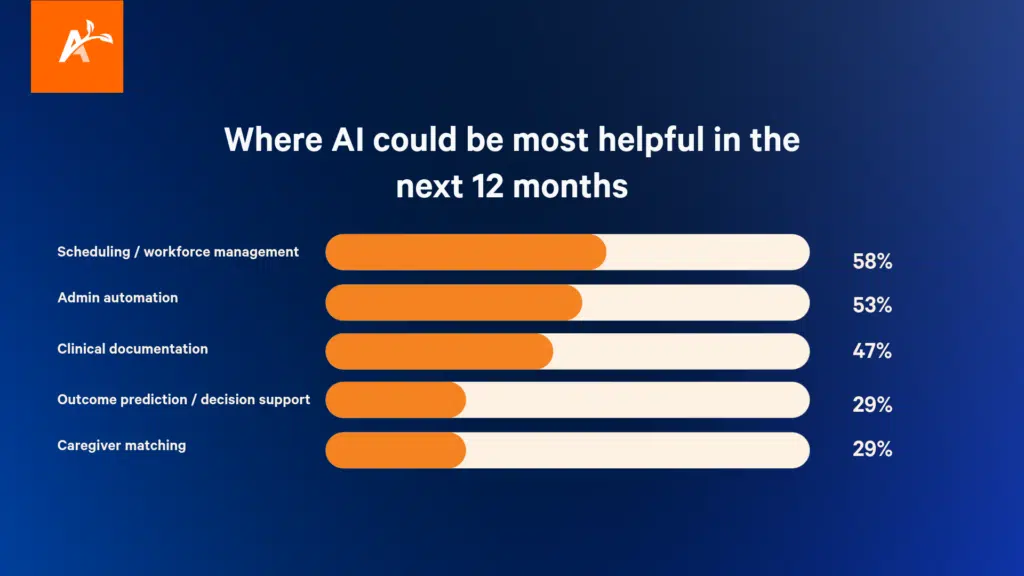
42% of organizations aren’t using AI yet — a number that reflects caution more than resistance. When asked where AI could add the most value over the next 12 months, 58% pointed to scheduling and workforce management, 53% to back-office automation, and 47% to clinical documentation. Those three areas map directly onto where providers are already in the most pain, which means AI adoption, when it comes, will be demand-driven rather than hype-driven.
The panel’s consistent advice: start small and contained. CBI Health deployed AI first in their call center — 150,000 calls a month — using sentiment analysis to flag difficult calls, generate summaries, and surface coaching opportunities. No clinical risk, clear inputs, measurable outputs. Avid Health at Home started with documentation automation in their private duty nursing team and saw an immediate lift in job satisfaction among LPNs and RNs. Both cases share the same logic: prove value in a bounded area before expanding. And in both cases, the human stayed in the loop — the panel was unanimous that AI should reduce administrative burden, not replace the judgment or relationship that makes home care work.
“AI should be an enabler, not a threat. I liken it to the shift from paper scheduling to digital scheduling — it’s the same kind of generational technology jump. Start small, get your feet wet, and build confidence as it evolves.”
Andrew Prahalad — VP of IT, CBI Health
One theme all three panelists agreed on: AI is only as good as the data feeding it. Organizations that haven’t cleaned up their intake processes and data quality first will struggle to get value from AI later.
Growth depends on people, efficiency, and visibility
The underlying data opportunity remains largely untapped. Caregivers spending 20–25 hours a week with a client accumulate observational insight that no clinical visit can replicate — early signs of decline, behavioral changes, emerging risk factors. Getting that information into a structured, shareable form is both a care quality improvement and a competitive differentiator. In Canada, that ambition runs into structural barriers: fragmented systems across hospitals, funders, and government agencies, and complex health data custodianship rules that make interoperability slow. Progress there requires policy movement alongside technology investment.
“Our caregivers average 20 to 25 hours a week with these clients — more than some of their own children. They know these people better than anyone. The opportunity is getting that information into the right hands, fast enough to matter.”
Jen Lentz — CEO, Avid Health at Home
What Real Partnerships Look Like
Visibility into real-time clinical data — not dashboards reviewed after the fact
Shared metrics agreed on upfront — not just the ones that make your organization look good
Regular cadences to review data together, not just reports sent and forgotten
A clear answer to the referral source’s question: how does working with you make my outcomes better?
One strategy for 2026: From each panelist
The challenges surfaced by this survey are familiar — workforce shortages, fragmented systems, constrained reimbursement. What’s shifting is the quality of the response. Providers are making more targeted bets, approaching AI with concrete use cases rather than open-ended ambition, and thinking harder about what it actually takes to build a referral partnership worth having. The organizations moving forward are the ones treating caregiver experience not as a separate priority from growth, but as the foundation of it.
“Organizations don’t get stuck in strategy — they get stuck in execution. Build change management into every initiative, name who owns it, and make sure tactics have people executing at the ground level.”

Rob Simione, SimiTree
“Don’t try to boil the ocean. Pick one theme — for us in 2025 it was speed. Ask yourself why things are slow and you’ll find a waterfall that touches every part of the business.”

Jen Lentz, Avid Health at Home
“Digital readiness is a mindset, not a toolset. If you have 30 priorities that are all priority one, you have no priorities. Use what you already have, start small, and build confidence from there.”

Andrew Prahalad, CBI Health
The challenges surfaced by this survey are familiar — workforce shortages, fragmented systems, constrained reimbursement. What’s shifting is the quality of the response. Providers are making more targeted bets, approaching AI with concrete use cases rather than open-ended ambition, and thinking harder about what it actually takes to build a referral partnership worth having. The organizations moving forward are the ones treating caregiver experience not as a separate priority from growth, but as the foundation of it.
Watch the full webinar
Get the complete roundtable discussion, survey data, and live Q&A on demand.
Watch the full webinar
Updated , originally published