Category: Family Portal

The key to better client experience? Improving communication between home-based care providers and clients

Resource Hub
Blog

The key to better client experience? Improving communication between home-based care providers and clients

Balancing both operational efficiency and delivering exceptional client experience is a constant objective for which home-based care agencies strive. 

The idea of a one-size-fits-all approach in home-based care is disappearing, as every client has specific and unique needs and preferences that require personalized attention. A client-centered care approach encourages active collaboration and shared decision-making between clients and their circle of care.    

But how can agencies provide more client-centered care to boost client experience and increase operational efficiencies?  

Answer: Improve communication and transparency between providers and clients. 

The role of communication and transparency in client-centered care 

A fundamental element of client-centered care is communication and transparency between providers and clients. Communication is vital in home-based care. It’s not just about sharing information; it’s the key to ensuring clients and their families are well-informed and involved in decisions. 

For instance, a study on decision-making by older adults in home-based care found that the most frequently reported barriers to decision-making were a lack of information about options and confusion due to information overload. 

However, communication isn’t just between the client and the caregiver. It includes everyone involved in the client’s circle of care. Involving this support network ensures everyone is on the same page and can contribute to the care plan. 

Agencies can partner with clients, their families, and caregivers by prioritizing communication and transparency. This partnership leads to better outcomes and a more supportive care environment. 

In short, good communication isn’t just a tool—it’s the foundation of successful home-based care. 

Top communication challenges faced by home-based care agencies 

Many home-based care agencies face communication and transparency challenges when dealing with their clients. Some of these challenges include: 

  1. High call volumes and extended wait times create an administrative burden and frustrate clients.  
  2. No access to information in a centralized area leads to dissatisfaction and complications in coordinating care.  
  3. Privacy concerns regarding client data underscore the need for HIPAA-compliant practices.  
  4. There is a lack of access to schedules and the ability to request visit updates, which leads to frustrated clients and communication breakdowns around avoidable scheduling conflicts.  
  5. Lack of cost transparency and billing information creates barriers for clients to stay on track of their payments and understand costs.  
  6. The difficulty for clients and families accessing critical care information directly impacts client engagement in their care and, ultimately, their outcomes. 

How do we deliver excellent client communication and transparency?  

Leveraging technology can help home-based care organizations improve communication and collaboration with clients. By employing appropriate digital tools, agencies can ensure that all parties are consistently updated about care plans, health status changes, and other relevant information, promoting a more collaborative care environment. 

Consider utilizing client portals. 

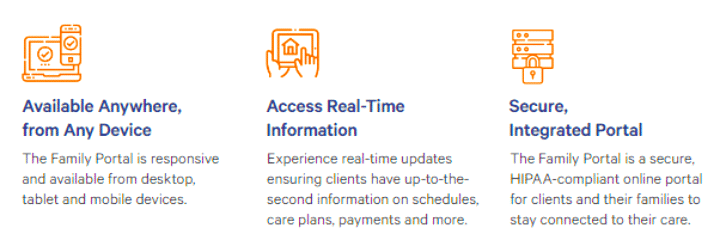
Client portals, such as AlayaCare’s Family Portal, are online portals that offer secure, two-way asynchronous information exchange. They allow clients and authorized family members to rate their care team, process payments, and access their health care information anywhere and anytime. This helps them become active and empowered members of their care plans, making it easier to make quick decisions and coordinate in delivering client care. 

“Through secure client portals such as AlayaCare’s Family Portal, family members can seamlessly participate in the care process, fostering a collaborative environment that further enhances the effectiveness of care delivery.” 

Adrian Schauer, CEO of AlayaCare, Top 5 predictions for home-based care in 2024. 

Enhance agency efficiency and client satisfaction with AlayaCare’s Family Portal 

Agencies can increase operational efficiencies, and clients can access their care information and needs securely and conveniently through a centralized portal. 

With AlayaCare’s Family Portal, agencies benefit from: 

1. Improved communication between agency and client 

Reduce wait times with a two-way asynchronous information exchange within the Family Portal between the agency and client/circle of care. This will allow both parties to communicate without making phone calls or waiting on hold. This improved communication establishes trust and rapport between providers and clients. This trust is essential for fostering a positive therapeutic relationship and promoting client engagement in their care.  

2. Enhanced client transparency with essential care information and billing 

Clients should have access to their upcoming visits on a calendar and the ability to make changes quickly without going through multiple steps. The Family Portal makes care plans and necessary information easily accessible. This includes all information from past visits, documents, and other essential details.  

“Scheduled visits are what we’ve observed as the number one piece of information clients and their care circle we’re looking for regularly. So, granting them access to these schedules and their care information in a centralized portal is core to enhancing their care experience and feeling more engaged with their care plans. With Family Portal, providers can be better equipped to overcome potential miscommunications. And perceived lack of communication.”

Yiou Huang, Senior Product Marketing Manager at AlayaCare, Enhanced Family Portal: The Family Portal Experience at Nucleus Independent Living Live Platform Tour. 

Additionally, billing and invoices should be available directly in the portal, allowing clients to see the costs of care services and pay directly within the portal. This feature can provide greater transparency and ease of use for clients. 

“Because of my […] disability, it’s important that I know who’s coming, and now I know,” said a Family Portal user through an in-app client survey.  

3. Better client health outcomes 

Clear and accurate communication helps prevent medical errors and ensures client safety. With Family Portal, providers can minimize the chances of adverse events by conveying information about medications, care plans, progress notes, and potential risks.   

“The key benefits of a centralized portal for clients are increased convenience and secure access for clients and the care circle. For home-based care agencies, operational efficiencies are essential. These benefits can lead to better outcomes through improved preventive and follow-up care quality by bringing all this information to the tip of your clients’ fingers.”

Yiou Huang, Senior Product Marketing Manager at AlayaCare, Enhanced Family Portal: The Family Portal Experience at Nucleus Independent Living Webinar. 

4. Shared decision-making with clients and their families 

Effective communication empowers clients to participate actively in their care decisions. Home-based care providers can facilitate shared decision-making and enhance client satisfaction by providing comprehensive information, discussing care plan options, and considering clients’ preferences within the portal.  

Key Considerations from Nucleus Independent Living

Leveraging technology to its fullest potential can be transformative. While platforms like AlayaCare’s Family Portal offer immense value, it’s essential to recognize that their effectiveness hinges on more than just activation. As Nucleus Independent Living exemplified during The Family Portal Experience at Nucleus Independent Living Webinar, simply having access to a Family Portal isn’t enough; it requires a strategic approach to maximize its benefits. 

During the webinar, Karin Archer Myles and Bushra Kundi from Nucleus Independent Living emphasized that the Family Portal is more than a passive tool—it’s a strategic vehicle for communication and client empowerment. By focusing on a guided onboarding experience, Nucleus ensures clients fully understand how to activate their accounts and how to use the platform from the outset. By leveraging their Care Team Leads and their existing client relationship, Nucleus lays the groundwork for continuous meaningful engagement and collaboration between clients and caregivers. 

Ultimately, the key takeaway is clear: technology has the potential to revolutionize client-centered care. However, its value lies in implementing a well-thought-out activation strategy prioritizing effective communication and empowerment. By adopting this approach, providers can unlock the full potential of technology such as AlayaCare’s Family Portal to enhance the care experience for their clients. 

Watch our on-demand webinar to learn more about AlayaCare’s Family Portal

Family Access to Home Healthcare Software and Baby Boomers – A Perfect Match

Resource Hub
Blog

Family Access to Home Healthcare Software and Baby Boomers – A Perfect Match

Since launching our Family Portal module back in September we have had a talk track that has been consistent – families have historically been disconnected and challenged with coordinating care for loved ones as well as keeping an eye on the care and progress – our Family Portal integrated into our own back office solution or for that matter any home healthcare software solves that challenge.

For the most part we have highlighted technology adoption rates of baby boomer trending higher and higher, closing in their younger counterparts.

The baby boomers are key to the Family Portal value proposition and mission – they provide agencies with the most robust ROI for enhanced communication.

Provide family members with visibility and control whether they are monitoring dad’s knee surgery from across the ocean or aunt Ruth’s foot care from downtown Calgary.

Luke Yoquinto pens a wonderful description of how one baby boomer essentially created her own family portal to deal with her mom’s care in his excellent piece in the Washington Post.

The moral of the story for agencies is – your clients’ families are ready, willing, very much able and in some cases already doing it on their own with Google Docs or using Facebook.

Instead of having your receptionist answering calls or receiving frustrated emails from a family member who feels disconnected, granting portal access enhances engagement for family members dealing with homecare and in many cases assisting in family care-giving. Enhancing engagement for clients and their family members increases their continuity of care which is an important step in providing quality service to your clients, read our blog on 5 tips to increase continuity of care to learn more and learn how to Leverage Digital Patient Engagement Tools to Improve Outcomes

Supporting patient, caregiver and family engagement with technology

Resource Hub
Blog

Supporting patient, caregiver and family engagement with technology

Families have turned away from nursing homes and other institutionalized settings at record rates over the last few years. Instead, they’re choosing home care for their loved ones. As a result, home care organizations are not only caring for more clients – but more clients with acute and complex needs.

It’s far from the only new demand for home care organizations. Value-based Medicaid payments have finally rolled out across nine states in 2022, with many more states forecasted to follow shortly. Agencies accepting these reimbursements are required to deliver better outcomes and back these claims up with data.

Between changing payer rules, consumer preferences, and acute client health needs, the demands on the home care industry are higher than ever. Agencies must learn to do more with the same resources as the caregiver shortage continues to strain the sector.

The good news for home care leaders? New digital tools and strategies also continue to evolve to support these changing needs. AlayaCare CEO & Founder Adrian Schauer, predicts that the technology industry will rise to the challenge, offering digital tools that enable innovative home care agencies to adapt to the new care landscape over the next few years.

Curious about how your organization can adapt to these new demands? On three recent episodes of Home Health 360, AlayaCare’s podcast offering global perspectives on home healthcare hosts Jeff Howell and Erin Vallier spoke with industry leaders about how they leverage novel tools and implement programs to increase engagement across entire clients’ entire circle of care.

Use clinical providers as coaches for home care providers

Home care clients require more complex care plans than ever. As a result, caregivers and nurses need to complete more involved ADLs than ever before.

Lourdes Wiley, Clinical Educator and Nurse Consultant, and Irina Gorovaya, Home Health Consultant, Educator, and Founder of Amity Healthcare Group, explored the importance of staff training and competency programs at home care agencies during Episode 14 of Home Health 360. They shared recommendations for agencies seeking to maximize their share of the growing acute home care market while providing complex care safely.

Goravaya suggests that agencies reimagine their competency program from a box-checking event to a transformational program. “You’re setting up the grounds to not only ensure you have skilled and knowledgeable personnel – but most importantly, to get better patient outcomes with better knowledge and better skills,” says Goravaya.

As a consultant, Wiley reviews many clinical charts for personal care agencies. She notes, “There’s a norm of expecting home health nurses to figure it out. But we shouldn’t be expecting this; it’s dangerous. We arm them with the why – why is this important, why does this work?”

Wiley and Goravaya frequently encounter agencies hesitant to train caregivers who might leave within three months. But they recommend that organizations not only look at competency programs as an investment in staff retention.

Hiring a competency training consultant, like Amity Healthcare Group, is an excellent option for many agencies. But this is something many organizations could take on themselves if they have a clinical leader willing to spearhead this – and the funds to invest in training equipment.

Once you’ve implemented new competency training for your team to take their skills to the next level, ensure you’re setting, tracking, and measuring the new metrics you can now achieve. Lean on your home care software provider for the tools to create and manage client care plans. And then ensure you’re tracking and reviewing ADLs via a care worker mobile app.

Leverage new tools to educate and empower caregivers

Providing different outcomes for clients means using new tools. And perhaps some new perspectives.

In Episode 2 of Home Health 360, Mari Baxter, COO, and David Chandler, Senior Director of Strategic Programs at Senior Helpers Franchising, shared how they use innovative caregiver training that has proven effective at keeping their clients out of hospital and living at home for longer.

The team at Senior Helpers has implemented a hands-on training course for caregivers where they roleplay care scenarios, find & remove hazards and learn practical new techniques in a four-room apartment setting. And they offer it to clients’ families as well.

While it’s not a traditional approach, Baxter notes, “I can have a caregiver in a client’s home from nine to five. But then a family member comes in and doesn’t know how to use a Hoyer lift or a tub bench properly. What good is it if we can only keep clients safe while we’re there?”

And they don’t stop at family training – everyone at Senior Helpers goes through the same program, including executives.

Their hands-on technique has successfully kept their clients living independently for two months longer on average. But Baxter shares that it’s also increased client satisfaction: “Families can rest assured if they hire someone from Senior Helpers that we have verified our caregivers’ skillset.”

And what’s even better? It’s attracting caregivers to their organization. Baxter says, “It’s so fun to watch caregivers call you up and say – can I come to your training? I heard you guys have this fun training. That’s never happened to me before. 

Implement messaging tools that connect the client’s care team

Although many technologies across the Internet of Things, such as wearables, passive alarms, and virtual assistants, have made big promises about how they can transform the home care industry – few have made a significant impact so far. In Episode 9 of Home Health 360, Intrepid USA CEO John Kunysz pointed out, “Seniors don’t want to wear Life Alerts. It’s a badge of dishonor. The technology exists, but it hasn’t been integrated in a way that seamlessly fits into a patient’s environment.”

So how can innovative home care agencies use technology to enhance communication – and improve outcomes? By leveraging Family Portals that connect and engage the entire circle of care: clients, loved ones, caregivers, and agency leadership.

How do messaging tools like Family Portal improve outcomes? They allow clients and their loved ones to:

  • Request a different frequency of recurring visits or request one-off visits
  • Take a more significant role in the care plan by reviewing goals, inventions, and progress
  • Keep track of medications and vitals shared on the portal
  • Improve caregiver-client matching through confidential personnel reviews
  • Share updates from other care providers that may otherwise not be communicated

For many agencies, client retention can be as challenging as caregiver retention. Family Portals increase patient engagement and participation in care and reduce client turnover.

Engaging the circle of care with technology

There are many paths to better care using innovative techniques and strategies. But one tool connects all your options: technology.

Intrepid USA CEO John Kunsyz’s advice for home care organizations on picking the right technology platform? “Think about where you want to be three to five years from today.”

While there isn’t one technique that will single-handedly transform patient, caregiver, and family member engagement – there is one technology platform that can unite your tools: AlayaCare. We propel agencies to the future of home care with solutions that improve clinical outcomes, measure & manage key performance metrics and give caregivers the tools to do their best work. And you won’t want to miss our new and improved Family Portal.

Connect with us today to discover how we can support your organization as you deliver the next generation of care.


How to Leverage Digital Patient Engagement Tools to Improve Outcomes

Home healthcare providers have an increased focus on “patient engagement”, or in the words of Judith Hibbard, Ph.D., MPH, “an individual’s knowledge, skill, and confidence for managing their [own] health and health care.” 

There is plenty of research that supports the notion that patients who are confident and who can participate in their own care are more likely to experience better outcomes while reducing hospital readmissions. 

This is becoming increasingly important for the at-home care industry as it continues shifting to value-based and patient-centric care. 

(more…)

Home healthcare providers have an increased focus on “patient engagement”, or in the words of Judith Hibbard, Ph.D., MPH, “an individual’s knowledge, skill, and confidence for managing their [own] health and health care.” 

There is plenty of research that supports the notion that patients who are confident and who can participate in their own care are more likely to experience better outcomes while reducing hospital readmissions. 

This is becoming increasingly important for the at-home care industry as it continues shifting to value-based and patient-centric care. 

(more…)

5 Tips for Improving your Client’s Home Care Experience

Like many other industries, the home care industry is beginning to put the consumer at the core. Care models are becoming increasingly client-centric, meaning customer service will be hands-down the most important role at your home care agency. This is especially true considering the increasing demand for home healthcare services; clients will be attracted to, and stay with, providers who offer an efficient and effective, consumer-centric experience.

(more…)

Like many other industries, the home care industry is beginning to put the consumer at the core. Care models are becoming increasingly client-centric, meaning customer service will be hands-down the most important role at your home care agency. This is especially true considering the increasing demand for home healthcare services; clients will be attracted to, and stay with, providers who offer an efficient and effective, consumer-centric experience.

(more…)

Family Portal: Keeping home care clients connected to their own care

When it comes to home care, there is no bigger stakeholder than the client. Long considered just the recipients of care, the conversation has now fully shifted: each of us is the most critical member of our own care team. We should have the freedom to ask questions, take charge of our own health, be responsible and accountable for our own treatments, and determine what medical care we should receive. 

(more…)

When it comes to home care, there is no bigger stakeholder than the client. Long considered just the recipients of care, the conversation has now fully shifted: each of us is the most critical member of our own care team. We should have the freedom to ask questions, take charge of our own health, be responsible and accountable for our own treatments, and determine what medical care we should receive. 

(more…)

Coordinate and Integrate Care With the Right Software

The business of home care is about the well-being of clients, and care for those clients is best provided in a harmonized fashion. Each client, in the role as patient, connects with the health-care system in various ways.

(more…)

The business of home care is about the well-being of clients, and care for those clients is best provided in a harmonized fashion. Each client, in the role as patient, connects with the health-care system in various ways.

(more…)

Efficiency Tweaks Can Position Agencies Well Amid Changing Home Care Landscape

At AlayaCare, we firmly believe that altering the delivery of care in small, strategic ways can open doors to newfound efficiencies. These will be key for home care agencies that aim to deliver top-quality service, seize industry momentum, and stay nimble with changing times.

(more…)

At AlayaCare, we firmly believe that altering the delivery of care in small, strategic ways can open doors to newfound efficiencies. These will be key for home care agencies that aim to deliver top-quality service, seize industry momentum, and stay nimble with changing times.

(more…)

How Technology Can Improve Hospice Operations and the Overall Quality of Care

Resource Hub
Blog

How Technology Can Improve Hospice Operations and the Overall Quality of Care

Advances in homecare technology have led to exciting possibilities for home health and hospice organizations. By adopting technology solutions, providers are seeing enhancements in their care delivery, and improvements in business results by reducing costs and ensuring accuracy of clinical documentation.

Hospice care can be difficult work, and therefore it becomes more important for care workers to avoid distractions and tedious workflows.

By implementing an end-to-end software solution, hospice care providers have the ability to seamlessly capture data in real-time and have access to more information, allowing them to focus on what’s truly important – providing the highest quality of care possible.

Here are just a few features of a comprehensive end-to-end software platform that can improve hospice operations and the overall quality of care:

Point of Care Documentation

Care providers using an electronic solution at the point of care have the ability to reference key information in real-time during the client visit without being disruptive.

An easy-to-use platform can also help improve documentation accuracy by eliminating human error and illegibility. In the case of an emergency, should the client’s care provider not be available, an on-call provider can quickly access the patient record and make a well-informed decision without having previously interacted with that patient.

Having access to this real-time information is extremely valuable.

Scheduling

Scheduling full-time, part-time, contracted staff and volunteers can be an overwhelming task. Coordinators and administrative staff need to keep in mind provider continuity, unavailability, and a number of other factors when scheduling visits, which proves to be extremely difficult when the hospice is running on paper processes.

With the help of an electronic solution, the hospice agency will be able to limit paper processes, including paper schedules and time sheets, and more accurately schedule employees taking into consideration both theirs and their clients, wants, needs and preferences.

Stakeholder Portals

Another resource that has proven to be helpful to clients in hospice care agencies is client and family portals.

Having a source where key stakeholders are able to share reports, updates, and any notes given to them by the provider increases transparency and keeps everyone informed as necessary.

Family members gain peace of mind that they are included in the entire process, even when they are physically unable to be with their loved one receiving care.

In a recent study, 47 percent of 163,000 patients enrolled were in hospice for the last 6 months of their lives.

With such a large and consistently increasing number of patients in the hospice space, it’s imperative to have the appropriate resources in place in order to sustain growth and demand.


AlayaCare is a provider of an end-to-end home healthcare software solution focused on improving agency outcomes through the use of next-generation technology.

If you’ve been running your agency on paper and are tired of wasting time and money on tedious processes, AlayaCare is here to help.

Reach out for a consultation today and learn how we can help your agency increase efficiencies and overall client outcomes.

4 Outcome-Based Features Your Home Care Software Needs to Improve Wound Care Management

Wound care is easily one of the largest needs for home care services. According to the Canadian Home Care Association it is estimated that roughly one-third of all home and community care clients have wound care needs and 50% of care delivered by home care programs involves the management of wounds.

Home healthcare professionals are faced with daily challenges related to wound management and the assessment and treatment of a variety of wounds. Without the appropriate tools, accurate documentation and consistent collaboration amongst clinicians, it becomes more and more difficult to successfully manage would care programs.

(more…)

Wound care is easily one of the largest needs for home care services. According to the Canadian Home Care Association it is estimated that roughly one-third of all home and community care clients have wound care needs and 50% of care delivered by home care programs involves the management of wounds.

Home healthcare professionals are faced with daily challenges related to wound management and the assessment and treatment of a variety of wounds. Without the appropriate tools, accurate documentation and consistent collaboration amongst clinicians, it becomes more and more difficult to successfully manage would care programs.

(more…)